How Hybrid War and Escalation Risks Affect the Economy
15 FEB 2022Authors – KSE Institute
Previously, we described scenarios for a Russian military offensive which businesses should prepare for. In this op-ed, we summarize our calculations of how much hybrid warfare and the risks of escalation cost now, and how much they might cost in the future.
Benchmark
In 2022, Ukraine’s economy is in a good shape both compared to the situation in 2014-2015 and in absolute terms. The macrofinancial situation is stable, the economy is diversified and no longer critically dependent on Russia. The energy intensity of the economy has significantly decreased, Ukraine can import gas from the European market, and Russia’s share in the structure of foreign trade has significantly declined (Russia’s share of Ukraine’s exports is 6% compared to over a quarter in 2013).
The hryvnia exchange rate gradually stabilized at 28.1 UAH/USD after a sharp loss of 6-7% of its value. The exchange rate was close to this level a year ago, in the early 2021.
The NBU has a sufficient level of reserves (about UAH 30 bn) to slow down possible devaluation in the coming months. The reserves cover about 4 months of future imports, indicating that the NBU has the capacity to smooth possible shocks in the foreign exchange market.
The Ukraine’s trade balance is positively affected by high grain prices (wheat price is near its historical highs), relatively high prices for metals (major Ukrainian export goods). High energy prices negatively affect Ukraine’s balance of trade (gas price at the European markets remains at USD 900-1000 per thousand cubic meters).
The energy situation is difficult but under control. Gas reserves in storage facilities are sufficient to get through the heating season at historic average temperatures, however, to cover demand in a short-term cold spell, Ukraine will start importing gas from Europe in February.
Channels of influence
Energy.
Russia uses gas prices, Nord Stream-2 and gas transit volumes and conditions as a weapon to influence Europe in general and Ukraine in particular. It is obvious that the crisis on the European gas market was created artificially by Russia.
Unlike other pipeline gas suppliers such as Algeria, Azerbaijan and Norway, Russia reduced its exports to Europe by 25% in Q4 2021 compared to the same period of 2020 and by 22% compared to 2019. This was despite exceptionally high market prices for natural gas in the second half of 2021.
Stabilization of gas market prices will require restoration of supply volumes from Russia to the European market to eliminate artificial deficit. However, now Russia is using the deficit to promote Nord Stream 2. If European countries agree to the Russian terms, then even with temporary balancing of prices, Russia will increasingly use gas and pipelines as an instrument of political influence.
Last year’s inflation in Ukraine was largely due to gas prices. Today Ukraine faces three challenges. First, during the current heating season it has to import gas at prices of USD 900-1000 per thousand cubic meters. This is a high price for business and the state budget (imports for the needs of the population and budget-financed institutions). Second, pumping expensive imported gas into storage facilities for the next heating season. Third, if the Nord Stream 2 is launched, Ukraine will have to import more gas and significantly rebuild its gas transportation infrastructure.
Cost of borrowing for the government.
The negative information background leads to capital outflows from the country. Non-residents are selling government bonds (since the beginning of the year they have sold UAH 13.4 bn of sovereign bonds). This situation can either remain for a while or end up quickly.
The war in the East of Ukraine has been negatively affecting Ukraine’s credit ratings since its start in 2014. In early 2022, just the information about the risks of conflict with Russia led to an increase in the sovereign risk premium (in January 5-year credit-default swaps for Ukraine became much pricier). Since sovereign risks are taken into account when assessing the riskiness of Ukrainian companies, this situation has worsened the ability of our businesses to attract credit.
Investments into real sector.
The risks of escalation can affect investors. So far, there is no statistics for 2022, but information about the risks of military action in the media does not help investors’ decisions to build, for example, production facilities in Kharkiv.
Capitalization of Ukrainian companies.
At the end of January 2022, six agrarian companies circulated at foreign stock exchanges had seen a decline in value. The capitalization of public Ukrainian agricultural companies during January 20 – January 26, 2022 changed as follows:
- • Kernel: declined by ▼0.2% to USD 1,098 mln;
- • Mironivsky Hliboproduct: declined by ▼0.6% to USD 668 mln;
- • IMC: declined by ▼8.4% to USD 213 mln;
- • Astarta-Kyiv: declined by ▼5% to USD 205 mln;
- • Ovostar Union: declined by ▼1.5% to USD 98 mln;
- • Agroton: declined by ▼12,3% to USD 30 mln;
- • Milkyland: increased by ▲6.2% to USD 12 mln;
- • Avangard: did not change and is USD 1 mln.
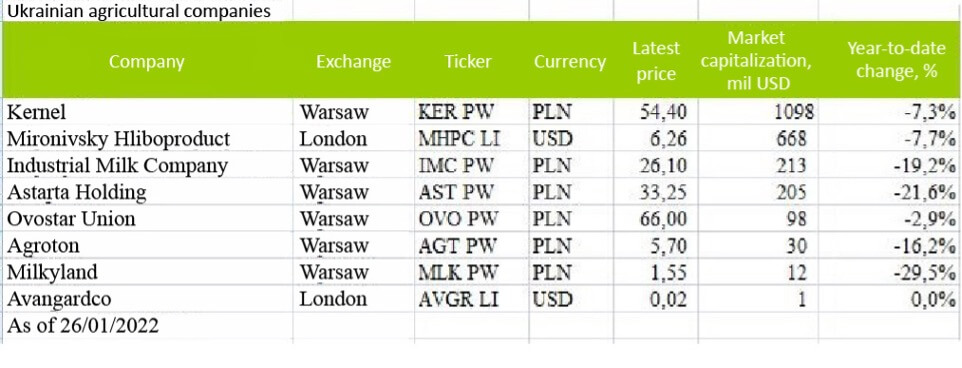 During the week of the most alarming news, six Ukrainian agriholdings saw their capitalization decline, and since the start of the year almost all of them have seen their share prices fall. Capitalization increased for one agriholding and did not change for another one.
Some of the companies used a significant drop in their share prices as an opportunity to buy back their shares. For example, Kernel purchased 3.38 million of its shares (4.02% of the share capital) at a price of PLN 56 per share for a total of PLN 189 million (about USD 45.98 million at the current exchange rate). This information was published on the website of the Warsaw Stock Exchange.
At the same time the Ukrainian stock indices (UX index and PFTS index) are not representative, as they have not significantly changed since the beginning of the year. This suggests that the domestic stock market has long been uninteresting for investors (during January 1st – February 4th 2022, there were 186 deals totaling UAH 13.8 million at the Ukrainian Exchange and just four deals for UAH 51 thousand at the PFTS).
Scenarios for 2022
SCENARIO 1. NORMAL CASE
Under this scenario, negative information background lasts during just the first quarter. Prices of Ukrainian exports remain high. Natural gas prices will fall by 40% after the end of the heating season but remain well above the five-year average.
Economic developments under this scenario:
Financial market: In the second quarter non-residents are gradually regaining interest in lending to the Ukrainian Government, but long-term loan rates (Eurobonds) are 2-3 p.p. higher compared to the end of 2021. Share prices of Ukrainian companies stop falling and an upward correction begins.
UAH/USD exchange rate: UAH 28.2-28.7 per USD, which is close to the state budget projections of 28.6.
International reserves decline from about USD 30 billion to USD 27 billion.
CPI inflation: About 7-8% year-on-year. Gas prices for households are 2.5-3.0 times lower than market prices.
SCENARIO 2. MODERATELY NEGATIVE CASE – HIGH GAS PRICES
Under this scenario natural gas prices remain at record high levels throughout 2022. Even after the end of the heating season European countries and Ukraine have to buy gas for underground storage facilities for the next heating season at high prices (forward contracts suggest that gas prices at the EU markets will be high throughout 2022). The International Energy Agency forecasts average spot prices of USD 945 per thousand cubic meters, the highest annual average ever. Prices of Ukrainian exports remains high.
Economic developments under this scenario:
Financial market: There are risks of a further drop in the share prices of Ukrainian companies.
UAH to USD exchange rate: UAH 29-30 per USD – up to 5% higher than the state budget forecast.
International reserves decrease from about USD 30 billion to USD 23 billion (also due to the need to offset the impact on demand for currency during the period of gas imports).
CPI inflation: About 9-10% year-on-year. Households gas prices are 4 times lower than market prices.
SCENARIO 3. NEGATIVE CASE – LOWER EXPORT PRICES AND HIGH GAS PRICE. Prices of Ukrainian exports fall by 15-20%. Gas prices remain high, consistent with the scenario 2.
Economic developments under this scenario:
Financial market: Non-residents are practically uninterested in lending to the Government, in particular, due to the increased state budget deficit. Share prices of Ukrainian companies continue to fall.
UAH/USD exchange rate: non-zero probability of devaluation to UAH 31-32 per USD (8-12% higher than budgeted) if NBU moderately restrains devaluation by interventions.
If the NBU allows a moderate devaluation because of the smaller inflow of currency from exports, the reserves would not decrease significantly compared to scenario 2 above.
CPI inflation: About 11% year-on-year. Households gas prices are 4 times lower than market prices.
Source: Forbes
Featured news